
At Toulouse University Hospital, CareLine Solutions is making a difference in remote cardiac monitoring

At Toulouse University Hospital, CareLine Solutions is making a difference in remote cardiac monitoring

Since October 2022, specialist nurse Ghislaine Galtier, who is part of Professor Michel Galinier’s team, has been using CareLine Solutions to monitor heart failure patients at Toulouse University Hospital. From the outset, she was impressed by the tool’s robustness: “For me, it’s the most reliable platform for patient monitoring,” she says without hesitation.

Une solution paramétrable et pensée pour la réalité clinique

Ghislaine Galtier highlights the reliability of CareLine Solutions, which she believes is based in particular on a responsive algorithm that doesn’t miss a thing: “Thanks to the CareLine Solutions remote heart failure monitoring platform, we don’t miss any essential signals. Changes in weight or blood pressure are detected immediately, sometimes even before the patient notices them. This precision has allowed me, on more than one occasion, to intervene early and thus avoid deterioration or even emergency hospitalization.”

Another essential aspect for Ghislaine Galtier is CareLine Solutions’ ability to adapt to the needs of each patient. She explains: “The standard settings are already relevant, but we can use the sliders to adjust the settings according to each patient. This ability to fine-tune the thresholds, particularly for our patients with very low blood pressure or unusual heart rhythms, avoids unnecessary alerts while maintaining a high level of remote monitoring.”

She also finds other features indispensable in her daily work. For example, biological test results are automatically uploaded to the platform: “They are the only ones to offer this option integrated with alert management and trend curves. In practice, we receive an alert to tell us that the test results have arrived, and even a sub-alert if a marker is outside the norm. It’s really convenient and essential for quality patient care,” she insists, still amazed that she no longer has to contact laboratories to obtain essential results.

Another feature she considers crucial is the integrated reminders for therapeutic optimization. “I chose to have an alert sent 72 hours later to remind me to check on that patient. I believe CareLine Solutions is the only one to offer this feature, and it’s really ideal because it means I don’t have to rely on a notebook or an external alert system and therefore forget to do an important check,” she explains.


A reliable and user-friendly remote monitoring platform for daily tracking

The platform’s ergonomics also play a key role in its adoption. Ghislaine Galtier appreciates this interface, which makes it easier to read and lightens her daily mental load: “The platform is very clear to use, ergonomic, fluid, and simple, but very comprehensive. It provides quick access to patient histories, useful documents, and graphs with very detailed plots.”

The variety of equipment available allows it to be tailored to the patient’s profile: “The latest solution, which involves simply adding a Withings connected scale, without a smartphone, is really great, especially for elderly people or those who are not comfortable with digital tools. Weight data is automatically transmitted to the CareLine platform.”

CareLine Solutions also offers ready-to-use educational materials: booklets, fact sheets, and printable documents that can be easily sent to patients. She appreciates this support because it helps to reinforce autonomy and understanding of the treatment.

As she uses the system, she sees the tangible impact on patients. Many see remote monitoring as a safety net. “They say to me, ‘I knew you were going to call me,’” she says, amused by the patients’ habit of relying on alerts and remote support.


A CareLine team that is always attentive, responsive, and committed

Beyond the technology, what really impresses Ghislaine Galtier is her relationship with the CareLine team: “I always get a very quick response, almost within an hour, whether it’s a technical request, a clinical question, or a question about equipment.” This responsiveness is also evident in the management of equipment. “When I need equipment, it’s always dealt with within the day and we receive it extremely quickly,” she reports, still impressed by the speed of execution.
She also highlights the quality of communication, which she describes as fluid, transparent, and constructive: “I speak very openly with them, especially with Thierry Poux, my direct contact, with whom I have a real relationship of trust. This allows me to communicate my needs without filter and to see the solution evolve concretely over the weeks. This permanent link with the CareLine Solutions team contributes directly to the positive and continuous evolution of the solution.”
CareLine Solutions: for 100% customizable remote monitoring of your heart failure patients

CareLine Solutions: for 100% customizable remote monitoring of your heart failure patients

In the context of remote monitoring of heart failure, Decree No. 2022-1767 of December 30, 2022, relating to the coverage and reimbursement of remote medical monitoring activities, stipulates that the only mandatory parameter to be monitored daily is weight.
CareLine Solutions has chosen to go well beyond this minimum requirement by offering comprehensive, personalized medical care focused on clinical expertise and care coordination.


A flexible, patient-centered monitoring model

CareLine Solutions offers up to 20 clinical parameters, which are optional and can be configured according to the patient’s actual needs.
Each cardiologist is free to choose the parameters they wish to monitor for each patient.
By default:

  • Weight = mandatory
  • All other parameters = optional

Thus, patient A may only have their weight monitored, while patient B will have monitoring that includes weight, blood pressure, and a symptom questionnaire. This approach highlights a key principle: adapt to the patient, never the other way around.
This monitoring is prescribed and managed by the cardiologist, but coordinated with the healthcare teams: nurses, IPA, ISPIC, etc., who become key players in longitudinal monitoring, within a secure and structured framework.


What parameters can be monitored using CareLine Solutions?

CareLine Solutions allows for the monitoring of around twenty clinical parameters, offering personalized and adaptable follow-up for each patient with heart failure. With the exception of weight, which is the only mandatory parameter, all other data is optional and can be activated or deactivated depending on the clinical situation.
Each parameter has a specific clinical relevance for the remote monitoring of heart failure:

  • Weight is a key indicator of fluid retention; rapid weight gain may indicate the onset of congestion.
  • Blood pressure allows treatments (ACE inhibitors/ARBs, beta-blockers, diuretics) to be adjusted and enables early detection of hypotension or destabilizing hypertension. CareLine Solutions provides healthcare teams with blood pressure monitors to equip patients if necessary.
  • Heart rate provides information on atrial fibrillation control, the effectiveness of beta-blockers, and overall hemodynamic status.
  • Symptoms identified via the EPOF questionnaire (shortness of breath at rest, shortness of breath on exertion or dyspnea, weight gain, edema, fatigue, orthopnea) enable a simple and sensitive assessment of clinical progression.
  • Oxygen saturation quickly detects respiratory deterioration or worsening pulmonary congestion.
  • Biomarkers provide essential additional biological information:
    – NT-proBNP/BNP assess filling pressure and the degree of decompensation;
    – urea and creatinine monitor renal function, which is often fragile in these patients;
    – Potassium and sodium reflect fluid and electrolyte balance and guide treatment adjustments;
    – Hemoglobin helps detect anemia, which aggravates heart failure;
    – Ferritin contributes to the diagnosis of iron deficiency, a factor in fatigue and exercise intolerance.

These various biological analyses are transmitted by laboratories via secure messaging and are then automatically imported into the CareLine IC platform. Depending on the settings configured by the remote monitoring team, these results may generate alerts.
In addition, for patients with a Medtronic implantable cardiac device, several parameters from the medical device are automatically transmitted and integrated directly into the CareLine IC platform :


  • 6 arrhythmia alerts : daily atrial fibrillation load above a threshold, high ventricular rate during an AF episode, shock delivered, sustained VT/VF, supraventricular tachycardias, and non-sustained VT. These alerts enable early detection of any rhythm deterioration that could destabilize the patient’s clinical condition.
  • 3 hemodynamic alerts : OptiVol™ pulmonary overload index, decrease in biventricular resynchronization percentage, HF Triage™ HF risk level. These provide continuous assessment of cardiac status and risk of decompensation, facilitating rapid and targeted intervention.
  • 1 communication failure alert that signals an interruption in remote monitoring and ensures continuity of surveillance.
    Episodes and EGMs are also transmitted and imported automatically.

Internal customization for each parameter

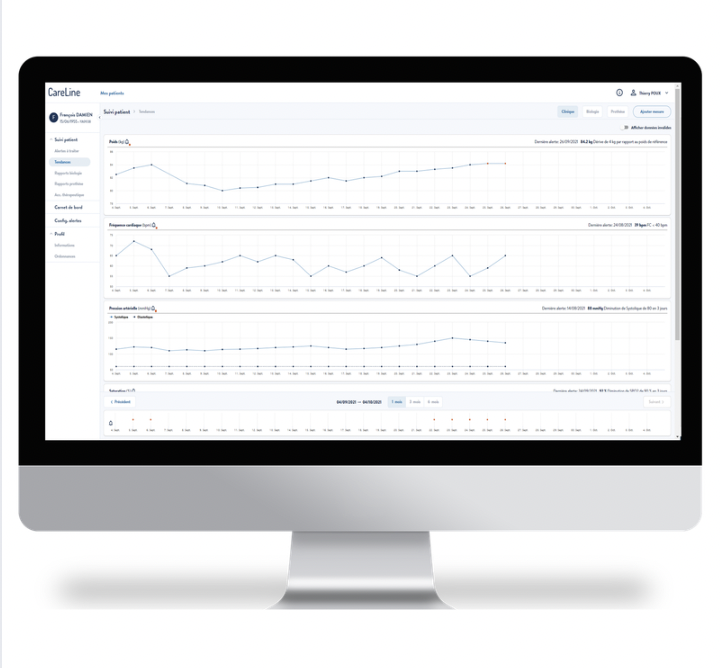
This means that the care team can define the clinical parameters to be monitored for each patient. For each of these parameters, the team can fully customize the alerts by configuring thresholds, periods, and variations.

Example: weight, the only parameter required for remote monitoring of heart failure

Weight is the only parameter that must be monitored remotely on a daily basis according to regulations, and the alerts can be configured as desired:

  • alert for weight gain: x pounds over x days (from 1 to 21) (configurable but cannot be disabled, according to legal regulations)
  • alert for positive weight drift
  • alert for negative weight drift
  • alert for lack of weight communication (number of days configurable but alert cannot be disabled, according to legal regulations)
  • possibility of disabling certain alerts if they are not relevant to the patient

The cardiologist retains control over 100% of the options. CareLine Solutions does not impose a fixed protocol, does not generate uncontrollable automatic alerts, and does not constrain the practice in its organization: it supports medical practice.


Anticipate decompensation, avoid hospitalizations

The data collected is not only used to alert healthcare professionals: it also helps stabilize patients remotely. By relying on detailed monitoring, CareLine Solutions makes it possible to adjust treatments early on, reduce the burden on emergency departments, and prevent unnecessary hospitalizations.

📊 Clinical results:

  • -75% fewer hospitalizations (Ploux study, ESC Heart Failure, 2023)
  • 88% of episodes of deterioration detected remotely (Ploux study, ESC Heart Failure, 2023)
  • 85% of decompensations managed at home (Ploux study, ESC Heart Failure, 2023)
  • +1 year of real-life survival in high-risk patients (Florence study, JACC HF, 2025)