In the context of remote monitoring of heart failure, Decree No. 2022-1767 of December 30, 2022, relating to the coverage and reimbursement of remote medical monitoring activities, stipulates that the only mandatory parameter to be monitored daily is weight.
CareLine Solutions has chosen to go well beyond this minimum requirement by offering comprehensive, personalized medical care focused on clinical expertise and care coordination.
A flexible, patient-centered monitoring model
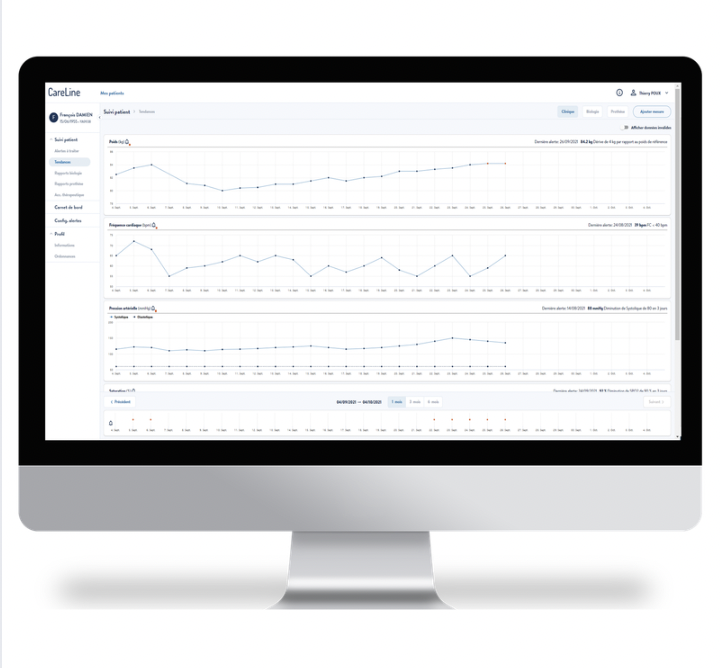
CareLine Solutions offers up to 20 clinical parameters, which are optional and can be configured according to the patient’s actual needs.
Each cardiologist is free to choose the parameters they wish to monitor for each patient.
By default:
- Weight = mandatory
- All other parameters = optional
Thus, patient A may only have their weight monitored, while patient B will have monitoring that includes weight, blood pressure, and a symptom questionnaire. This approach highlights a key principle: adapt to the patient, never the other way around.
This monitoring is prescribed and managed by the cardiologist, but coordinated with the healthcare teams: nurses, IPA, ISPIC, etc., who become key players in longitudinal monitoring, within a secure and structured framework.
What parameters can be monitored using CareLine Solutions?
CareLine Solutions allows for the monitoring of around twenty clinical parameters, offering personalized and adaptable follow-up for each patient with heart failure. With the exception of weight, which is the only mandatory parameter, all other data is optional and can be activated or deactivated depending on the clinical situation.
Each parameter has a specific clinical relevance for the remote monitoring of heart failure:
- Weight is a key indicator of fluid retention; rapid weight gain may indicate the onset of congestion.
- Blood pressure allows treatments (ACE inhibitors/ARBs, beta-blockers, diuretics) to be adjusted and enables early detection of hypotension or destabilizing hypertension. CareLine Solutions provides healthcare teams with blood pressure monitors to equip patients if necessary.
- Heart rate provides information on atrial fibrillation control, the effectiveness of beta-blockers, and overall hemodynamic status.
- Symptoms identified via the EPOF questionnaire (shortness of breath at rest, shortness of breath on exertion or dyspnea, weight gain, edema, fatigue, orthopnea) enable a simple and sensitive assessment of clinical progression.
- Oxygen saturation quickly detects respiratory deterioration or worsening pulmonary congestion.
- Biomarkers provide essential additional biological information:
– NT-proBNP/BNP assess filling pressure and the degree of decompensation;
– urea and creatinine monitor renal function, which is often fragile in these patients;
– Potassium and sodium reflect fluid and electrolyte balance and guide treatment adjustments;
– Hemoglobin helps detect anemia, which aggravates heart failure;
– Ferritin contributes to the diagnosis of iron deficiency, a factor in fatigue and exercise intolerance.
These various biological analyses are transmitted by laboratories via secure messaging and are then automatically imported into the CareLine IC platform. Depending on the settings configured by the remote monitoring team, these results may generate alerts.
In addition, for patients with a Medtronic implantable cardiac device, several parameters from the medical device are automatically transmitted and integrated directly into the CareLine IC platform :
- 6 arrhythmia alerts : daily atrial fibrillation load above a threshold, high ventricular rate during an AF episode, shock delivered, sustained VT/VF, supraventricular tachycardias, and non-sustained VT. These alerts enable early detection of any rhythm deterioration that could destabilize the patient’s clinical condition.
- 3 hemodynamic alerts : OptiVol™ pulmonary overload index, decrease in biventricular resynchronization percentage, HF Triage™ HF risk level. These provide continuous assessment of cardiac status and risk of decompensation, facilitating rapid and targeted intervention.
- 1 communication failure alert that signals an interruption in remote monitoring and ensures continuity of surveillance.
Episodes and EGMs are also transmitted and imported automatically.
Internal customization for each parameter
This means that the care team can define the clinical parameters to be monitored for each patient. For each of these parameters, the team can fully customize the alerts by configuring thresholds, periods, and variations.
Example: weight, the only parameter required for remote monitoring of heart failure
Weight is the only parameter that must be monitored remotely on a daily basis according to regulations, and the alerts can be configured as desired:
- alert for weight gain: x pounds over x days (from 1 to 21) (configurable but cannot be disabled, according to legal regulations)
- alert for positive weight drift
- alert for negative weight drift
- alert for lack of weight communication (number of days configurable but alert cannot be disabled, according to legal regulations)
- possibility of disabling certain alerts if they are not relevant to the patient
The cardiologist retains control over 100% of the options. CareLine Solutions does not impose a fixed protocol, does not generate uncontrollable automatic alerts, and does not constrain the practice in its organization: it supports medical practice.
Anticipate decompensation, avoid hospitalizations
The data collected is not only used to alert healthcare professionals: it also helps stabilize patients remotely. By relying on detailed monitoring, CareLine Solutions makes it possible to adjust treatments early on, reduce the burden on emergency departments, and prevent unnecessary hospitalizations.
📊 Clinical results:
- -75% fewer hospitalizations (Ploux study, ESC Heart Failure, 2023)
- 88% of episodes of deterioration detected remotely (Ploux study, ESC Heart Failure, 2023)
- 85% of decompensations managed at home (Ploux study, ESC Heart Failure, 2023)
- +1 year of real-life survival in high-risk patients (Florence study, JACC HF, 2025)